
A New Species in the Quantum Zoo Is a Candidate for a Fractional Topological Insulator
Xiaoyang Zhu’s group at Columbia finds the first experimental evidence for this coveted quantum phase
Last year, Columbia researchers expanded the quantum zoo with the discovery of a dozen new “species” of quantum states in a special class of two-dimensional (2D) materials that form moiré superlattices when stacked and twisted. The researchers, led by Xiaoyang Zhu, have been busy learning more about these previously hidden states, including one that could be a fractional topological insulator.
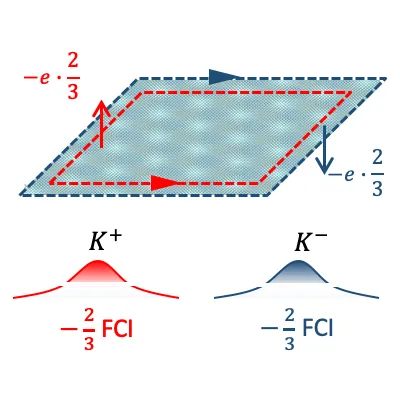
“This is likely the first experimental evidence for a coveted quantum phase, the fractional topological insulator, which has remained a theoretical prediction for the past 15 years,” said Zhu, Howard Family Professor of Nanoscience at Columbia.
A fractional topological insulator is insulating in the 2D bulk but conducting via “helical edge modes,” which describe counterpropagating “spin up” and “spin down” channels that preserve a physics law called time-reversal symmetry. The topological nature of this state may render these edge currents robust to imperfections in the material and to external disturbances. The quantum computing community is interested in topological states as a means to store and process quantum information while minimizing errors.
The current paper, published today in the journal Physical Review X, was led by graduate student Gillian Minarik and postdoc Yiping Wang, co-first authors. They adapted the lab’s extremely sensitive pump-probe spectroscopy technique to use circularly polarized light to probe magnetism in “moiré” superlattices, which have emergent properties driven by enhanced electronic interactions. Upon doping with excess electrons or holes, the superlattice forces these carriers to arrange in collective ways to form various quantum phases.
Minarik and Wang’s state of interest occurs at ⁴⁄₃ holes, or electron vacancies, doped per moiré unit cell. Such a ⁴⁄₃ fractional state can, in theory, be created when two ⅔ fractional states, known to be fractional Chern insulators, combine, explained Minarik. In Chern insulators with opposite spins, the spins should cancel each other out, giving zero net magnetization, as the team initially observed; this signature is consistent with the preservation of time-reversal symmetry. But when the team added a minute magnetic field, the sample became magnetic, an unexpected result for moiré systems. The transition was fragile and fleeting, but clear.
The results, which appear between twist angles of 3.7 and 3.9 degrees, match theoretical predictions for a fractional topological insulator composed of two Chern insulators with opposite spins. Definitive proof will require transport measurements to determine whether helical edge currents are indeed present, but Minarik, Zhu, and their colleagues are excited about the prospects—and hope others will be too.
“The implications for this discovery are very exciting, extending beyond the long-sought putative FTI,” said Minarik. “If this is true, the binding of two FCI copies with opposite chiralities provides the first evidence for pairing of fractional charges in the first Chern band. This observation paves the way for realizing more exotic topological states stabilized through pairing, such as non-abelian anyons, which hold particular promise for defect-tolerant quantum computing. This is only the beginning.”
Read More: Yiping Wang, Gillian Minarik, et al. Candidate for a Fractional Topological Insulator in Twisted MoTe2. Physical Review X (2026). DOI: 10.1103/bvrb-z4hj