
Columbia Physicists Observe Ultracold Molecular Droplets
They open up a new world of quantum physics that researchers can uniquely control.
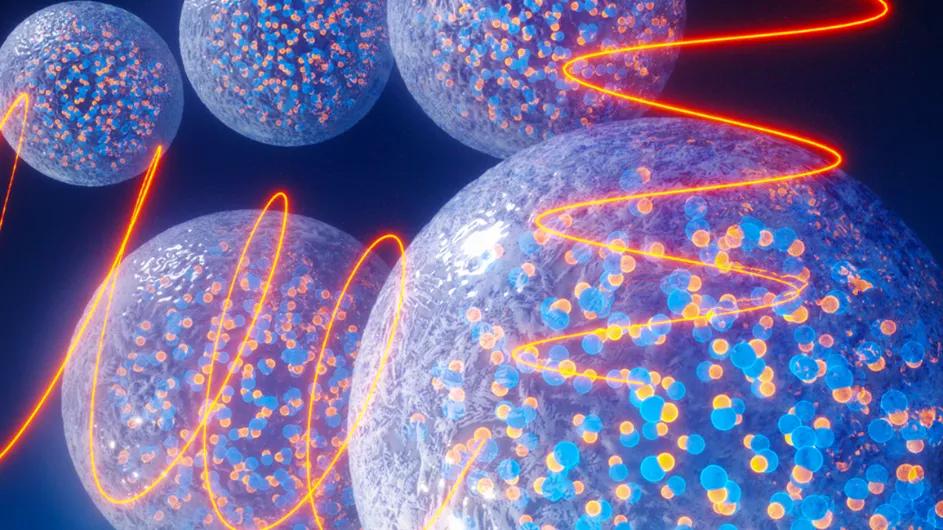
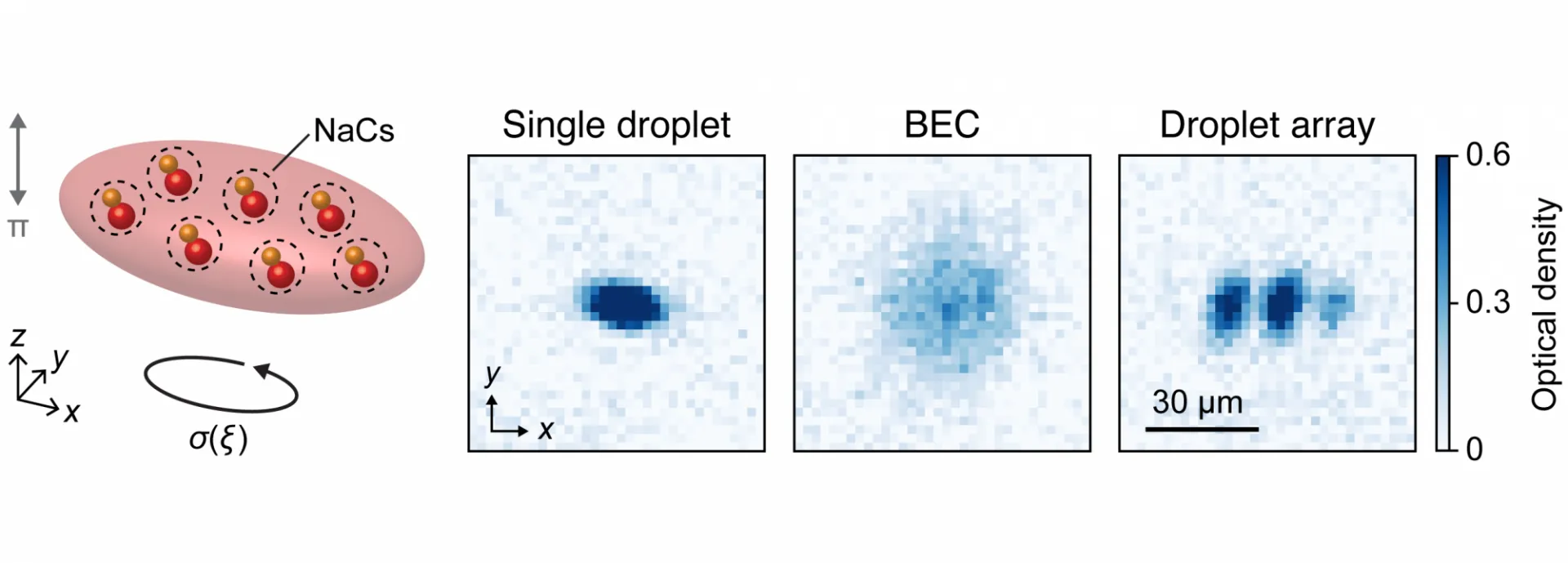
In 2024, physicist Sebastian Will’s lab at Columbia University carefully coaxed ultracold gases of sodium–cesium (NaCs) molecules into Bose-Einstein Condensates (BECs)—the first time molecules entered this unique quantum state of matter predicted a century ago by physicists Satyendra Nath Bose and Albert Einstein. Writing again in Nature, Will and his team have now watched their BECs self-organize into a new form of matter: strongly dipolar droplets.
Droplets form all over in nature, from water vapor condensing into rain to interstellar molecular gases collapsing into stars. Similar processes may have even played a role in the early universe, where quarks and gluons had to agglomerate and puddle together to form the first particles. The first observed superfluid, ultracold helium, also forms droplets.
Researchers may now be able to explore these phenomena, as well as others, such as the formation and properties of superfluids and solid crystals, in a highly controlled way in tabletop experiments. “We have a unique system with an amazing level of control, with which we can now study droplet formation at the quantum level,” said Will.
The NaCs molecules the Will lab uses are dipolar: one end is slightly positively charged; the other, slightly negatively charged. Similar to bar magnets, they can attract or repel each other depending on their orientations. The resulting long-range dipole-dipole interactions can lead to exotic quantum behavior.
Over the past decade, atomic physicists have observed intriguing phenomena, such as quantum droplets and supersolidity in magnetic atoms, despite their relatively weak dipolar interactions. Compared to magnetic atoms, interactions between NaCs molecules can be hundreds of times stronger and reach across a much longer range. In this work, Will and collaborators show for the first time quantum phases of ultracold molecules that are driven by strong dipole-dipole interactions.
To do so, they invented a new way to control dipolar interactions between molecules called “microwave dressing.” Using two microwave fields, they can dynamically tune the strength of the interactions between the molecules.
Upon reaching a certain threshold, the BECs began to shrink rapidly, forming stable droplets 100x denser than before. “That suggests we are reaching the strongly-interacting regime for the first time,” said Will. “We now have the opportunity to observe the self-organization of quantum matter that can occur in this regime, and build a bridge between atomic, molecular, and optical physics and condensed matter physics in a new way.”
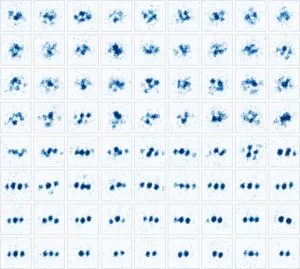
One possibility is to create a new kind of superfluid. Superfluids, like liquid helium, flow without friction and have a number of other unique quantum properties. In addition to dense macrodroplets, the BECs can also self-assemble into crystal-like structures. These arrays of droplets might even behave like supersolids, which exhibit frictionless flow like a superfluid but are arranged in a fixed, periodic structure.
Modeling droplet formation and understanding the underlying physical mechanism that stabilizes them are intriguing challenges for theoretical physicists, and Will’s team has been amazed by what they’ve observed in the lab so far. “This is quantum mechanics under our control, and we are observing interactions that no one has ever seen before,” said Siwei Zhang, first author of the current Nature paper.
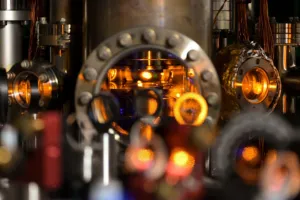
The team is now preparing to look more closely at the droplets; in the current experiment, they were so dense and small that it was hard to see their exact shapes. To zoom in, the team is now developing a higher-resolution imaging system to peek inside the droplets—and deeper into a new world of strongly interacting quantum matter at ultracold temperatures.
Read More: Siwei Zhang et al. Observation of self-bound droplets of ultracold dipolar molecules. Nature (2026). DOI: 10.1038/s41586-026-10245-9