
This Columbia Startup Wants to Take Computer Chips to the Atomic Limit
Graduate students Nick Olsen and Luke Holtzman launched Tessellate 2D to produce 2D semiconductors at scale.

The computer chips that power much of the world today all start out as nearly human-sized blocks of silicon. Over the years since scientists first recognized the promise of silicon in electronic devices, industry has perfected the process of growing ultrapure bulk crystals, which are then carved into wafers for further processing into the silicon chips now found everywhere in computers, phones, solar panels, and more.
But silicon can only be sliced, and then carved and etched, so thin. With concerns about Moore’s law slowing down and an upper limit for the number of transistors that can be physically packed onto a single chip nearing, a new startup from Columbia is looking to shrink semiconductors down to atomic scales…and skip the scotch tape.
In September 2025, graduate students Nick Olsen (GSAS Fall‘25) and Luke Holtzman launched Tessellate 2D to commercialize techniques they helped develop in the labs of Columbia faculty: Chemist Xiaoyang Zhu, mechanical engineer James Hone, and the late materials scientist Katayun Barmak. Their goal is to produce high-quality, ultrathin semiconductors for research and industry at scale: Just one of Tessellate 2D’s centimeter-sized crystals can yield over 100,000 2D layers.
In this Q&A, Nick and Luke explain the science behind Tessellate 2D and what it’s been like transitioning from an academic lab bench to a startup space.
Can you describe your PhDs at Columbia, and how you first came to work together?
Olsen: During my PhD with Xiaoyang, I worked on the gold exfoliation technique first published in Science in 2020 by postdoc Fang Liu (now a professor at Stanford). This is the gold-stamp technique that Tessellate now uses, but it needed some improvement. I was focused on making sure the process didn’t degrade the quality of the crystals we use, which we confirmed last fall in a paper published in Nano Letters.
Holtzman: I am studying materials science and engineering, previously with Katayun and now with Jim as my advisors. Prior to my arrival at Columbia, Jim’s group had been buying bulk TMD crystals, but Jim wanted to make better ones ourselves. I optimized a synthesis method [first published in by former Hone lab members in Nano Letters in 2019 and improved in ACS Nano in 2023] to actively control their size and flatness while minimizing defects.
We weren’t originally working together, but Nick and others in the Zhu lab needed cleaner crystals for some measurements. We realized that gold-stamping my crystals yielded really pristine, massive monolayer samples—better than what was possible with the conventional Scotch Tape technique, or gold exfoliation from commercial crystals.
Why did these techniques need to be improved in the first place?
Olsen: 2D materials have exploded in the last decade or so. They have unique properties, and all you really needed to create them was a crystal and a roll of Scotch tape. But the flakes you get are random and small. That’s fine for lab work, but not scalable for industry. On the other hand, attempts to grow single layers have had quality problems. The layers can be much larger than what is achievable with Scotch tape, but they often have missing atoms or problematic grain boundaries, for example.
Holtzman: If you think of these materials as a stack of paper, Scotch tape is like using a lawn mower to isolate a sheet, while direct growth is like trying to make one sheet at a time from pulp, over and over. We grow an identical stack of paper with millions of sheets.
Olsen: The gold stamp process is then like licking your thumb to grab only the top sheet.
Why are you working with Transition Metal Dichalcogenides (TMDs)?
Olsen: TMDs are 2D semiconductors that interact strongly with light as single layers. That means they have a lot of potential in optoelectronic devices, such as photoswitches and sensors.
TMDs also have desirable electronic properties for transistors. Silicon has been the basis of all of our electronics. There have been more silicon transistors produced than there are grains of sand on Earth. But after 80 years, the world is reaching the end of silicon electronics. Transistors need to be so small that silicon is starting to fail. Below a thickness of 5 nanometers—about 30 to 40 atoms—silicon’s properties decline precipitously. What we can create at Tessellate 2D is inherently just a surface, only two to three atoms thick, that maintains its semiconducting properties.
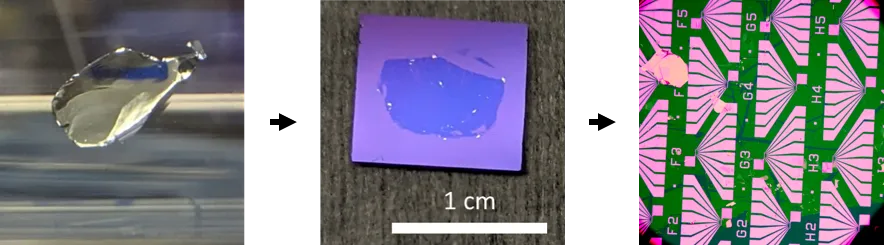
Holtzman: To extend Moore’s law another decade, we need new materials, and we need to be able to make them at scale. To have high-quality, you have to start with high-quality. Right now, in our startup space out in Newark, we are making “lab-scale” TMD crystals about a centimeter in size and installing the equipment to start synthesizing larger 2-inch crystals. We’re also prototyping how to automate the gold stamping process using robotics.
How has the startup transition been?
Holtzman: It’s exciting, but there really is no one to hold you accountable. Last year, I did an industry internship and saw firsthand that there are thousands of people working on optimizing computer chips, but this is just us. We can look to others to learn, but it's up to us to get things done. It feels like the world is our oyster. And it’s moving quickly! I remember getting a message from Nick right about New Year’s last year, just to get a coffee and chat about this idea. Not only are we up and running now, but we’re actively making sales.
Olsen: Every day is like a weekend…but we work on weekends. The tasks we do are very varied, but can be a bit boring. I’m learning about NJ tax law and insurance, for example—that’s a big learning curve from the lab. I also spent a lot of time learning about the incentives driving our customers in the semiconductor industry, our investors, and the university. But that’s how you grow. You need good technology, but you also need people to work together to help your fragile little snowball grow.
How has Columbia played a role?
Olsen: The nanomaterials field really grew out of Columbia, when people like Louis Brus came over from Bell Labs. That’s shaped it into such a collaborative culture that really persists to this day. Not many different departments would have enabled us to meet, let alone work together as we did at Columbia. And we owe a lot to our advisors, Jim, Xiaoyang, and Katayun. Besides just teaching us the technology, we’ve gotten such great advice.
Holtzman: It’s been really cool to see them get excited about the company and bringing their research ideas from the past ten, even twenty years, out into the world.
Olsen: They’ve spent their careers proving the potential of these ideas in their papers, and we’re privileged to help make that potential a reality.
Where did the name “Tessellate 2D” come from?
Olsen: It’s a math term that means “to tile space.” TMDs are made of hexagons that do just that.
The text has been updated to include references to the crystal synthesis technique developed in the Hone lab by former postdoctoral fellow Daniel Rhodes (now at the University of Wisconsin) and Song Liu (now at the Chinese Academy of Sciences), and graduate student Bumho Kim (SEAS '2020).