
Columbia Quantum Initiative Impact Report: July 2025 to June 2026

Columbia Quantum Statistics & Highlights From Our Past Academic Year, July 2025 to June 2026:
Our People
- 37 core faculty members with expertise in quantum physics and chemistry, photonics, materials science and engineering, and quantum computing
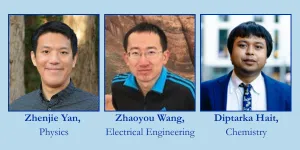
- Three new faculty members joined in the last academic year:
Our Awards & Honors:
John Bardeen and Heike Kamerlingh Onnes Awards for contributions to superconductivity research + New NSF CAREER Awards, Brown Investigators, Sloan Fellowships, and more...
The Next Generation:
+ 39 PhD students graduated in 2024 and 2025
+ 41 students enrolled in Columbia’s Quantum Science & Technology Master's Program
+ Dozens of postdoctoral fellows advancing quantum research
+ Hundreds of students from Columbia, Barnard, and those elected to undergraduate research experience programs have been exposed to the latest quantum research
Our Research
+ 266 research papers published, half as senior authors
+ 31 active research grants totaling over $66 million
+ 6 new patents filed
+ 3 start-ups launched
Quantum Centers include:
+ Department of Energy Energy Frontier Research Center on Programmable Quantum Materials
+ National Science Foundation Materials Research and Science Engineering Center on Precision-Assembled Quantum Materials
+ Max Planck-New York Center on Non-equilibrium Quantum Phenomena
+ National Science Foundation National Virtual Quantum Laboratory
+ Columbia Center for Computational Electrochemistry
Highlighted News
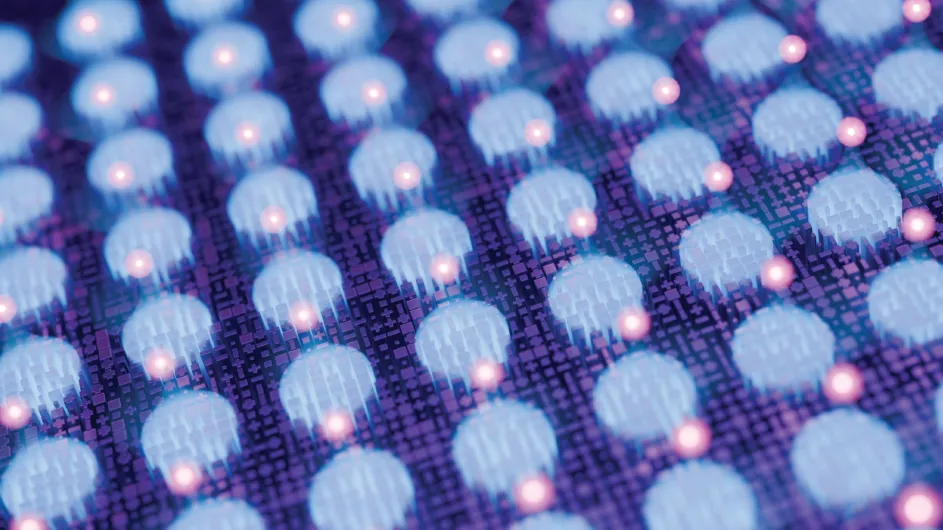
Neutral-Atom Arrays Are A Rapidly Emerging Quantum Computing Platform. Columbia Researchers Know How to Make the Biggest Arrays Yet. They combined optical tweezers with metasurfaces to trap over 1000 atoms—with the potential to capture hundreds of thousands more.
Columbia Connected to New York Quantum Network. Entangled photons will soon make their way instantaneously across the growing network, which now extends 70 miles from Long Island to Morningside Heights.
Columbia Makes the Case for Quantum on Capitol Hill. Universities will be critical to keeping America at the forefront of this rapidly advancing field, says research panel.
There’s a Range of Magic Angles to Study Superconductivity in a Twisted 2D Semiconductor. New research confirms that tungsten diselenide (WSe2) is a reproducible platform to explore the origins of frictionless flow.
Columbia Researchers Find Coherent Ferrons. The observed polarization waves advance the emerging field of ferronics, with implications from quantum technologies to telecommunications.
The Playbook for Perfect Polaritons. Columbia chemists identify the rules for creating quasiparticles that can power optical computers and quantum devices.
Consider the Chemistry of Your Quantum Materials. Atomic orbitals, not just crystal lattices, can yield frustrated materials with quantum results.
100 Years of Quantum at Columbia. 2025 marked a century of quantum science research. Learn about Columbia's central role in that history.
Matching Vibrations Is All It Takes to Modify Materials. Quantum fluctuations from the vacuum of a 2D material can drastically change the properties of a nearby crystal.
Superfluids are Supposed to Flow Indefinitely. Physicists Just Watched One Stop Moving. Signs point towards the first observation of a supersolid, an enigmatic quantum version of a classical solid.
Columbia Engineers Introduce Metasurfaces to 2D Materials. A simple new technique enhances nonlinear optical properties, and the potential to create entangled photons, without sacrificing size.
Taking the Temperature of Integrated Photonics. A thin resistor routinely used in photonic devices can also act as a thermometer—a simple feature that could help integrated photonics reach its full potential.
Columbia Physicists Observe Ultracold Molecular Droplets. They open up a new world of quantum physics that researchers can uniquely control.
Columbia Engineers Prototype New 2D Qubit. Atom-thin materials expand the options for constructing quantum computer chips while simultaneously shrinking their size.