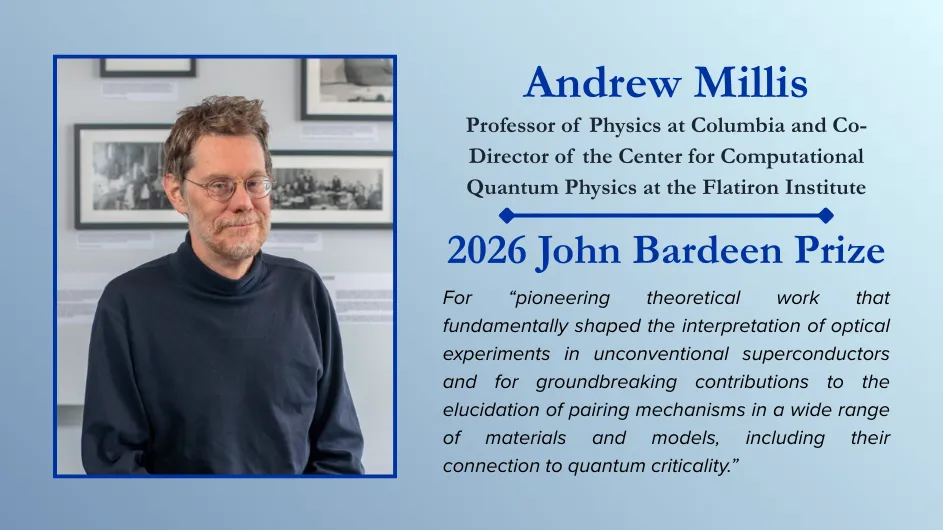
Andrew Millis, professor of physics at Columbia and co-director of the Center for Computational Quantum Physics at the Flatiron Institute, has been awarded the 2026 John Bardeen Prize for “pioneering theoretical work that fundamentally shaped the interpretation of optical experiments in unconventional superconductors and for groundbreaking contributions to the elucidation of pairing mechanisms in a wide range of materials and models, including their connection to quantum criticality.”
The work for which Millis is cited began in 1986 while he was a postdoctoral researcher at Bell Labs studying copper oxides. These unconventional superconductors that he studies, also known as the cuprates, are an important class of high-temperature superconductors discovered that same year. Millis developed important tools to interpret optical conductivity measurements, which reveal how electrons move and interact in these and other superconducting materials.
“Superconductivity is all about how electrons move, which depends on the ‘glue’ that pairs them together. Optical experiments are the most direct way to probe these features,” said Millis. “Superconductivity is an endlessly interesting subject, and it’s an honor to receive the Bardeen Prize.”
The John Bardeen Prize was established in 1991 by the organizers of the International Conference on the Materials and Mechanisms of Superconductivity (M2S) in honor of Dr. John Bardeen, two-time Nobel Laureate in Physics for his theoretical work on superconductivity and the transistor. The prize is sponsored by the Department of Physics at the University of Illinois and the Friends of Bardeen, and is given every three years at the M2S Conference.
Millis will share this year’s Bardeen Prize with Dung-hai Lee from the University of California, Berkeley, and Michael Norman from Argonne National Laboratory.
His colleague and fellow Columbia physicist, Yasutomo Uemura, has been awarded the 2026 Kamerlingh Onnes Prize for experimental contributions to superconductivity research, which will also be presented at the upcoming M2S Conference this July.