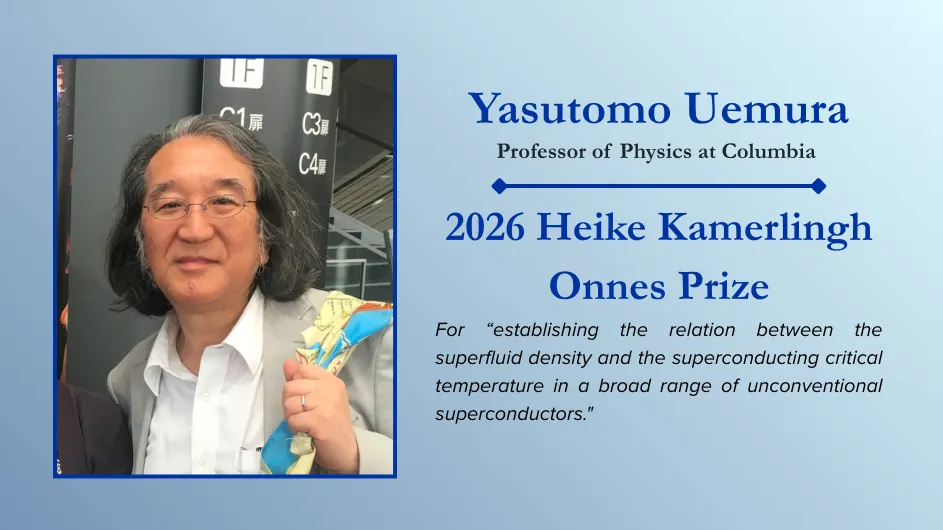
Yasutomo Uemura, professor of physics at Columbia, has been awarded the 2026 Heiki Kamerlingh Onnes Prize for “establishing the relation between the superfluid density and the superconducting critical temperature in a broad range of unconventional superconductors."
While completing his PhD at the University of Tokyo, Uemura mastered Muon Spin Relaxation (MuSR), a technique that measures magnetic fields in materials. When applied to superconductors, MuSR provides a readout of the number and mass of electrons involved in the superconducting shielding current. This is known as the superfluid density, and it counterbalances the applied magnetic field.
The relationship between the superfluid density and the superconducting transition temperature (Tc) for a material allows researchers to distinguish between different models of superconductivity. One model is the “BCS” theory of Bardeen, Cooper, and Schrieffer, which was awarded the 1972 Nobel Prize in Physics and works for simple metals like tin or aluminum; another is based on Bose-Einstein Condensation (BEC).
In the cuprates, a class of high-temperature superconductors discovered in 1986, Uemura used MuSR to identify a linear relationship between the superfluid density and Tc. This is now known as the Uemura plot. Subsequently, Uemura showed that alkali-doped C60, iron-based systems, and other new superconductors follow the same relationship.
“Superfluid density is an extremely important parameter for superconductivity. For researchers, it’s a nice challenge to try to explain why these materials superconduct at given temperatures, and for me, it’s an honor to receive the Kamerlingh Onnes Prize in recognition of my work, which suggests that a new model beyond the BCS theory is likely required,” said Uemura.
The Kamerlingh Onnes Prize was established in 2000 by the organizers of the International Conference on the Materials and Mechanisms of Superconductivity (M2S) in honor of Heike Kamerlingh Onnes, who received the Nobel Prize in Physics in 1913 for his discovery of superconductivity in mercury. The prize is sponsored by Elsevier and given every three years at the M2S Conference.
Uemura will share this year’s award with physicist Richard Greene from the University of Maryland.
His colleague and fellow Columbia physicist, Andrew Millis, has been awarded the 2026 John Bardeen Prize for theoretical contributions to superconductivity research, which will also be presented at the upcoming M2S Conference this July.