
Electron Interactions Are Key to Understanding Quantum Materials. Columbia Researchers Can Now Measure Them
A new technique will help fill in missing data needed to answer some of the biggest open questions in condensed matter physics.
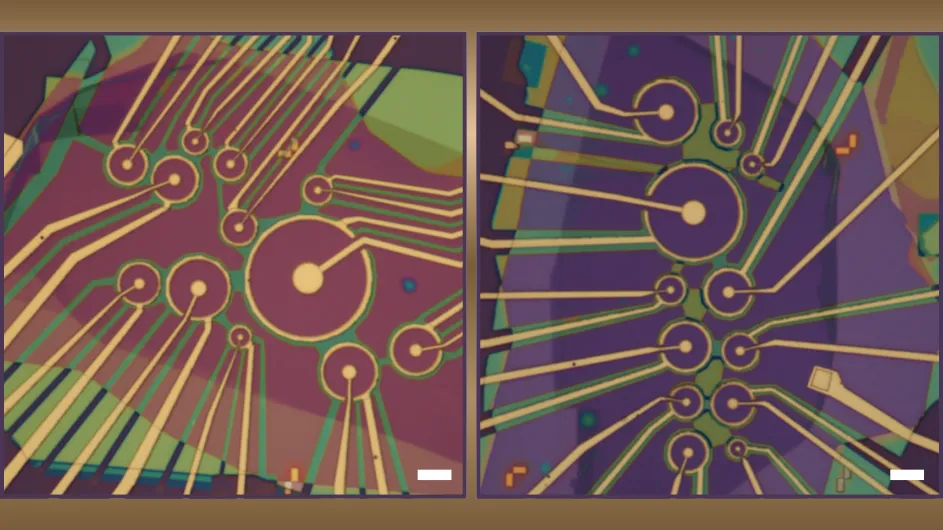
Interactions between electrons are believed to drive some of the most remarkable phenomena in quantum materials, including unconventional superconductivity, strange metals that defy conventional theories of electrical conduction, and exotic insulating states. But until now, they couldn’t be easily measured. In research published in Science, a team led by Columbia physicist Cory Dean has developed a new technique to quantify the rate at which electrons in a material interact. This electron interaction rate is a critical missing detail in condensed matter physics that will be essential for building predictive models of correlated electron behavior.
“When electrons in a material interact strongly with each other, the behavior tends to become strange and unexpected,” says Dean. “These cases with strongly interacting electrons are the most interesting, but the least well understood in part because we didn’t know how to measure the essential parameter in these systems: the rate at which electrons collide with each other. This is a fundamental problem in physics.”
When electrons flow through a material, their motion is impeded by collisions with vibrating atoms and impurities in the crystal. This is measured using standard resistance techniques, which helped physicists develop our conventional view of how single electrons move and explain why metals are metals and insulators are insulators, for example. But traditional resistance measurements cannot easily quantify interactions between electrons. Without a means to measure these interactions, they cannot be used to build predictive models that explain why quantum materials can behave in such unique and unexpected ways.
Around the 1960s, scientists proposed that materials with strongly interacting electrons could be modeled using a hydrodynamics framework. Hydrodynamics describes the motions of fluids, and the defining property of a fluid is its viscosity. But a problem remained: the rate at which electrons collide with the material usually overwhelms any electron-electron collisions. That changed about a decade ago, when researchers discovered that graphene cooled to around 100K (-279.67 °F) exhibits a pure type of hydrodynamic behavior—not because its electron-electron interactions are necessarily large but because there are minimal material collisions at that temperature. For the first time, graphene provided a platform on which electron hydrodynamic flow could be observed and its viscosity, which reflects electron-electron scattering, obtained. However, measuring the viscosity of an electron fluid remained difficult, indirect, and limited to an extremely narrow temperature window.
Learn More
Yihang Zeng, the lead author of the current Science paper, overcame this challenge with a new device he designed as a graduate student in the Dean lab. Zeng shaped graphene into a circular geometry, with electrical contacts arranged as concentric rings. The team then measured how electrical resistance between the inner and outer rings changed under a magnetic field. The magnetic field has a different influence on resistance and viscous flow behaviors, allowing Zeng and his colleagues to tease apart the rate of material collisions from electron-electron collisions, even when the former is overwhelmingly large.
“We have developed a technique that’s capable of measuring electrical resistance and electronic viscosity simultaneously,” said Zeng, who is now an assistant professor of physics and astronomy at Purdue University. “This allows us to now characterize electron behavior across a broad range of temperatures and densities, and we are no longer constrained to restricted experimental conditions.”
Like others, they found that 100K is indeed a sweet spot for electron fluids in graphene: electron-electron scattering dominates over any collisions against the crystal, and the flowing electron current behaves like a viscous fluid. For the first time, they were also able to use their technique to extract the viscosity as they tuned away from this sweet spot. Measuring the viscosity between about 30 kelvin (-406 °F) and room temperature, they found a surprising, inverse linear relationship between viscosity and temperature. That observation conflicts with simple Fermi Liquid Theory, which states that viscosity should increase with the inverse square of temperature. The team’s theoretical collaborators, Leonid Levitov at MIT and Haoyu Guo at Cornell University, suggest, however, that the observations are consistent with a recently proposed theoretical picture known as tomographic transport, in which different types of collective electronic motion relax at different rates.
“These results are a bit radical,” said Dean. “The very first measurement that we made already gave us a surprise. No doubt there will be more to come.”
Read More: Yihang Zeng et al. Quantitative measurement of viscosity in two-dimensional electron fluids. Science (2026). DOI: DOI: 10.1126/science.adr5469