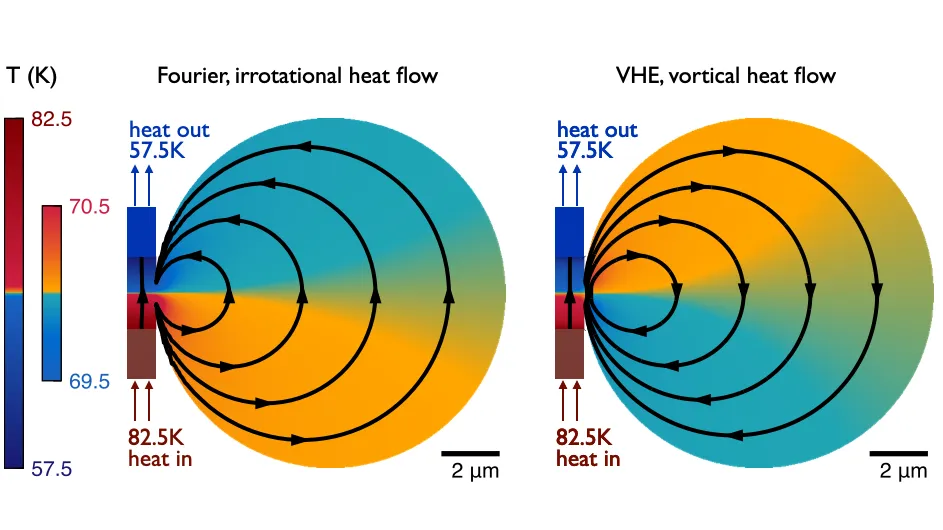
In 1822, French physicist Joseph Fourier formulated his law of heat conduction, an equation that elegantly describes how heat flows down a temperature gradient. But there are exceptions to the rule: materials in which heat, under the right conditions, can flow backward.
Writing in Physical Review Letters, Columbia University applied physicist Michele Simoncelli and his collaborators, Bogdan Rajkov from Cambridge University and Jan Dragašević from the University of Copenhagen, demonstrate how this counterintuitive phenomenon can be induced, controlled, and amplified. In certain layered materials, including graphite and hexagonal boron nitride (hBN), heat can move much like a fluid: ebbing, swirling, and rippling in waves. This departs from the diffusive behavior predicted by Fourier’s law and opens new avenues for managing and engineering thermal signals in a range of technologies.
“The physics of heat transport in layered materials shares fundamental analogies with classical fluids flowing in porous media; it can even form waves that can be modulated using resonance,” said Simoncelli, assistant professor of applied physics and applied mathematics at Columbia Engineering. “That suggests that heat could behave as a controllable signal, rather than a nuisance.”
The team employed quantum-mechanical simulations to solve viscous heat equations and predict non-diffusive heat flow in graphite and hBN, materials widely used in electronics and phononics for their high thermal conductivity. According to Fourier’s law, heat should evenly diffuse. But the team’s equations describe vortices, a smoking gun for viscous flow, as well as wave-like oscillations, which occur when heat moves against a temperature gradient.
The viscous heat flow in these materials originates from phonons, quantum-mechanical excitations associated with atomic vibrations in crystals, which can interact in ways that carry heat into coherent motion. The resulting viscosity is quite close to that of everyday liquids. “We found that the effective heat viscosity of graphite is similar to that of water, while boron nitride is more similar to toluene, commonly used in paints,” said Simoncelli.
This has two important implications for controlling heat flow in these materials. By adjusting their geometry through features such as circular wells, narrow channels, and tailored boundary shapes, researchers can intentionally create heat-flux gradients and vortices, much as fluids do when they encounter an obstacle. And by heating the materials with short pulses, they can excite temperature waves that can be amplified through resonance.
Experimentalists are already familiar with such approaches to induce different phenomena in layered materials, but have long considered heat a nuisance to be avoided. With their new understanding of heat flow, Simoncelli and his collaborators suggest that heat could become a controllable signal.
Read More: Jan Dragašević, Bogdan Rajkov, and Michele Simoncelli. Viscous heat backflow and temperature resonances in extreme thermal conductors. Physical Review Letters (2026). DOI: 10.1103/nbbn-56hr