
This Master’s Student is Combining Quantum Science, Chemical Engineering, and Podcasting
Antonella Navarro shares how she tries to find balance. Her tip? Block your calendar with an "MFA:" Mandatory Fun Activity.
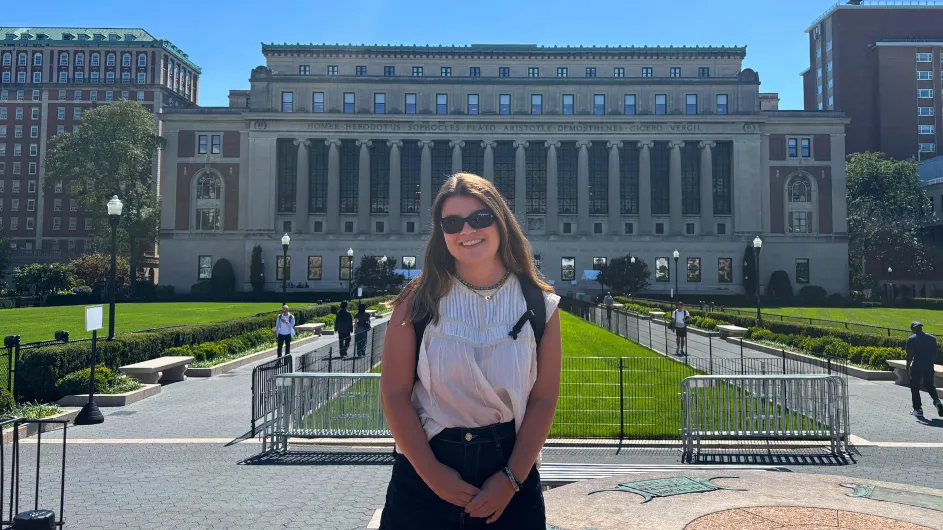
There’s a quantum revolution happening—and Columbia master’s student Antonella Navarro is helping bridge the people, ideas, and industries at the heart of it. Last summer, before she officially joined the second cohort of Columbia’s quantum science and technology master’s program, Navarro launched The Quantum Revolution Podcast, a series of in-person interviews exploring the people and breakthroughs shaping quantum technologies.
Earlier this year, she expanded to a longer, half-hour format with Caltech research and quantum computing pioneer John Preskill. Her latest episode, officially out today, covers quantum computing, AI alignment, and intellectual history with computer scientist Scott Aaronson from the University of Texas, Austin.
Navarro has a monthly queue building, all while she has her hands full with quantum classes and trying to take in the city as she approaches the halfway point of the 15-month master’s program.
In this Q&A, Navarro shares more about balancing her time and learning the language of quantum science.
How did you decide on Columbia for a quantum master’s?
I was a chemical engineering undergrad at McGill University, but I wanted to solely focus on quantum science and learn to speak that language. I love that our cohort is small, but interdisciplinary—it’s like a microcosm of the current workforce with physicists, computer scientists, and engineers learning to work together,
And New York is a plus. The culture is very cool, and there’s always something to do on Friday night: museums, galleries, concerts. Everyone wants to come visit.
How do chemical engineering and quantum science combine?
Chemical engineering is an older field with a lot of well-set rules. But there are so many engineering problems that we can’t address right now. Chemical processes are very complex, and we make a lot of approximations and assumptions. It’s frustrating when those assumptions translate into a loss of energy, of volume, etc., in the final product.
When I learned about quantum science, I thought, “This has to be able to help evolve our processes.” It’s about gaining performance and precision in the way we simulate things, which could really make an impact in the chemical industry. I am positioning myself to bridge emerging quantum vendors and established chemical industry segments.
I want to contribute to the redesign of critical industrial systems. I believe that the chemical industry is where things need to change, because a small process improvement can have a global impact.
What sparked your interest in science originally?
When I was younger, I got very interested in astronomy and physics…because my older brother was interested in it, and I did everything my older brother did. I started reading Hubert Reeves and Stephen Hawking during lunch break. I was also curious about how everything was made, and that's why I got into chemical engineering. I loved literature, but I thought it would be easier to do engineering and use my literary skills on the side.
How did the TQR Podcast come about?
While I was wrapping up my undergrad, I saw a gap in quantum media: it was either too vulgarized or too technical, and most often addressed one silo in particular, without drawing links between how different parts of quantum sciences intersect. I felt positioned to speak to technical people and help translate. I like understanding something from many angles and contrasting perspectives, so I approached it as infrastructure for the ecosystem—a way to document the people building the field while accelerating my own understanding of it.
Listen to TQR
It was cold emailing at the start—for my first, I randomly messaged Cassandre Notton at Quandela, who's a quantum machine learning engineer—she was also in Montreal, and about my age. And it was a go! We had so much fun.
It has since grown to over 30 interviews with quantum CEOs, VC partners, and researchers across two continents. Every conversation teaches me something about technical and strategic thinking, and the challenges remaining. Since I am French, seeing how the industry is evolving across Europe and North America has been especially interesting.
The audience spans quantum professionals, graduate students, investors, consultants, engineers from other sectors, and tech enthusiasts, with over 600 LinkedIn followers.
How do you balance it all?
I’m still learning. Before this fall, I had been doing very applied and advanced chemical engineering and it was a little hard to get back into physics and things that aren’t really tangible. The engineer in me was screaming internally, ‘There’s nothing to optimize!’
I was also actively recording and posting interviews on LinkedIn, but I hadn’t built good systems yet. It was super new with so many things to take into consideration: outreach, prep, filming, writing, positioning. But I’m picking up new tools, working on distribution, and now I have an editor.
I try to really separate school from TQR while integrating what I learn in each context. In my calendar, I also have what I call ‘MFA’: mandatory fun activity. Four hours, twice a week, I go out and do a New York adventure. I'm ambitious and I tend to move fast but lately I have been putting more intention on pausing and enjoying my life; you're not 23, studying quantum physics in New York all the time!
Where do you see yourself heading?
I’m very interested in industry, and I think my skills will be better used there. During my undergrad, I did an eight-month internship researching quantum applications with Siemens Energy and I learned a lot. I also have an interest, and a minor, in aerospace. I’m from Toulouse, and there’s a big aerospace industry there.
I’m excited to keep building a solid base to contribute meaningfully to this revolution, whether in class, behind the mic, or in industry.