
Photonics, Science Policy, and Rowing Around Manhattan
Q&A with 2026 Optica Ambassador and Columbia postdoc Sai Kanth Dacha
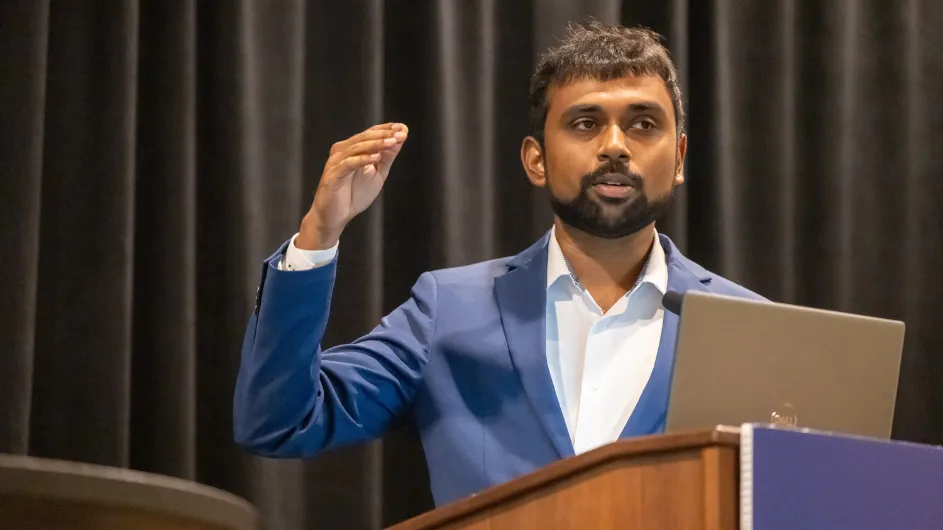
Sai Kanth Dacha’s research at Columbia is heating up—all in an attempt to keep photonics devices cool. A postdoctoral research scientist in Alexander Gaeta’s group in the Department of Applied Physics and Applied Mathematics at Columbia Engineering, Dacha has been exploring radically new ways to stabilize highly sensitive quantum and nonlinear photonic devices that are now part of a billion-dollar industry. Last Fall, in work sparked by a chance observation three years ago, he identified a new way to precisely monitor and stabilize the temperature of optical microresonators without needing any photodetection. The technique has the potential to drastically simplify a critical aspect of realizing practically viable photonic devices.
When he’s not busy in the lab, he’s dedicated to helping other scientists explain their research and expand their horizons. He was just selected as one of ten Optica Ambassadors, a program for early-career researchers to support the professional development of their younger peers.
“For my Optica Ambassadorship, I want to help guide new scientists on the things we don’t get good framing for, like how to give an impactful talk or speak effectively to nontechnical audiences. I’ve been lucky to have had many good mentors throughout my career that have helped me hone these important skills, but that isn’t the case for everyone,” said Dacha.
He’ll add event organizing to his plate this year, along with his photonics research and a newfound passion for rowing:
What was your path into photonics?
I went to the Indian Institute of Technology in Madras for my undergraduate degree in engineering physics. I did a lot of robotics work at first before I stumbled into photonics, first as part of a class taught by Deepa Venkitesh, then during a summer internship at Caltech with the LIGO Lab. LIGO has built not one but two Michelson interferometers here in the US, each with two 4km-long arms in which a highly stable and powerful laser bounces back and forth. By observing the tiniest of fluctuations in the interference signal, they detect gravitational waves from black-hole and neutron-star collisions that reach Earth billions of years later. It is the coolest optical experiment ever.
Working there inspired me to pursue a Ph.D. in physics in the US. I got into the physics program at the University of Maryland, where I worked with Tom Murphy on spatiotemporal nonlinear optical effects in multimode fibers. The telecom industry had been looking at multimode fibers and space-division multiplexing as potential pathways to improving per-fiber capacity in undersea networks. Simultaneously, groups at Cornell and Sapienza University had reported some fascinating new complex nonlinear physics in multimode fibers. Tom and I initially started off with an idea to use multimode fibers for neuromorphic computing, but quickly realized that much of the nonlinear physics in these fibers remained to be uncovered, so that became the topic of my dissertation.
How did your work take a quantum turn?
Towards the end of my PhD, I did an internship at Nokia Bell Labs. Alain Aspect, who would win the Nobel Prize in Physics the following year for his work on entanglement and showing the violation of Bell’s inequality, had been visiting just the week before I joined Bell Labs. His friend and my advisor, René-Jean Essiambre, an established expert in nonlinear fiber optics (originally charted to be the topic of my internship research), decided to jump into something new and quantum—I was the guinea pig.
We worked on exploring the fundamental limits of laser communications across the vastness of deep space: from Pluto and further out, back to Earth. This is generally done with microwaves, as in the Voyager missions, but space agencies have been interested in deploying lasers instead, as they have higher bandwidths and data rates, so you’d be able to gather and send back a lot more scientific information. But even with a strong laser, by the time light travels back to Earth, there are only a few photons left due to diffraction loss, so you get into the quantum regime and need single-photon detectors and sophisticated algorithms to recover the information.
Tell us about your research at Columbia.
Alex’s group has been the perfect sweetspot of what I already knew and what new things I could learn, and it’s been a great experience to collaborate with Michal Lipson’s group. Shortly after I joined, I somewhat accidentally discovered a whole new research avenue of temperature stabilization in photonics, which we published last fall.
The microresonator we stabilized in that paper is useful for frequency combs and generating quantum light sources, but industry often uses something different—a silicon ring modulator that was, in fact, invented in Michal’s lab back in 2005. It’s been cool to see something from the lab adopted widely in industry, including at NVIDIA. These ring modulators are still susceptible to environmental fluctuations, so we want to use our integrated thermometry technique to build a better industrial modulator. If applied the right way, this could save a lot of resources. We are also expanding the technique towards our quantum communication efforts and generating entangled photon pairs.
It’s been a very fruitful three years! I’ve also grown so much as a researcher. When I started, I felt like just an older Ph.D. student, but under Alex’s supervision, I’ve grown into my newfound role as a research scientist combined with a lab manager. There’s a lot of exciting optics work going on here at Columbia, and it’s an exciting time to be here and explore new ideas.
In addition to photonics, you are also interested in policy?
Yes, during my Ph.D., I took a science and technology policy class taught by Rosina Bierbaum and Jim Gates, who were members of President Obama's Council of Advisors on Science and Technology. A notable guest speaker was John Holdren, the first Assistant to the President for Science and Technology. Seeing scientists who had direct access to the president signified to me the growing importance of S&T policy in this century, which is increasingly defined by technology. The class sparked an interest in policy and science communications.
Among other things that were inspired by this class, I started doing some Congressional science advocacy, which helped me think about how to communicate research to non-technical audiences. I did one visit to Capitol Hill shortly after I joined Columbia, and one of the offices I visited was Mark Kelly’s. Here was someone with a science and engineering background in public office, and we, as a younger generation, inspired him to join the Congressional Optics and Photonics Caucus. Having that opportunity as a scientist in the lab to present my work and advocate for my field and research community has made me keen to continue my work in policy, though I’m not planning to leave the lab just yet.
Outside of the lab, what’s been a highlight from your time in New York?
Aside from exploring all that the city has to offer in terms of the arts & theater, music, food, outdoor spaces (I once played a chess hustler in Washington Sq. Park and beat him 3-0; he was not pleased…), I recently started rowing. Last Fall, I rowed around Manhattan in an event organized by the Village Community Boat House. You might think Manhattan is a small island; you can bike it in a couple of hours, but rowing is a different game. It took almost eight hours of rowing time, aside from breaks and waiting for the tides.
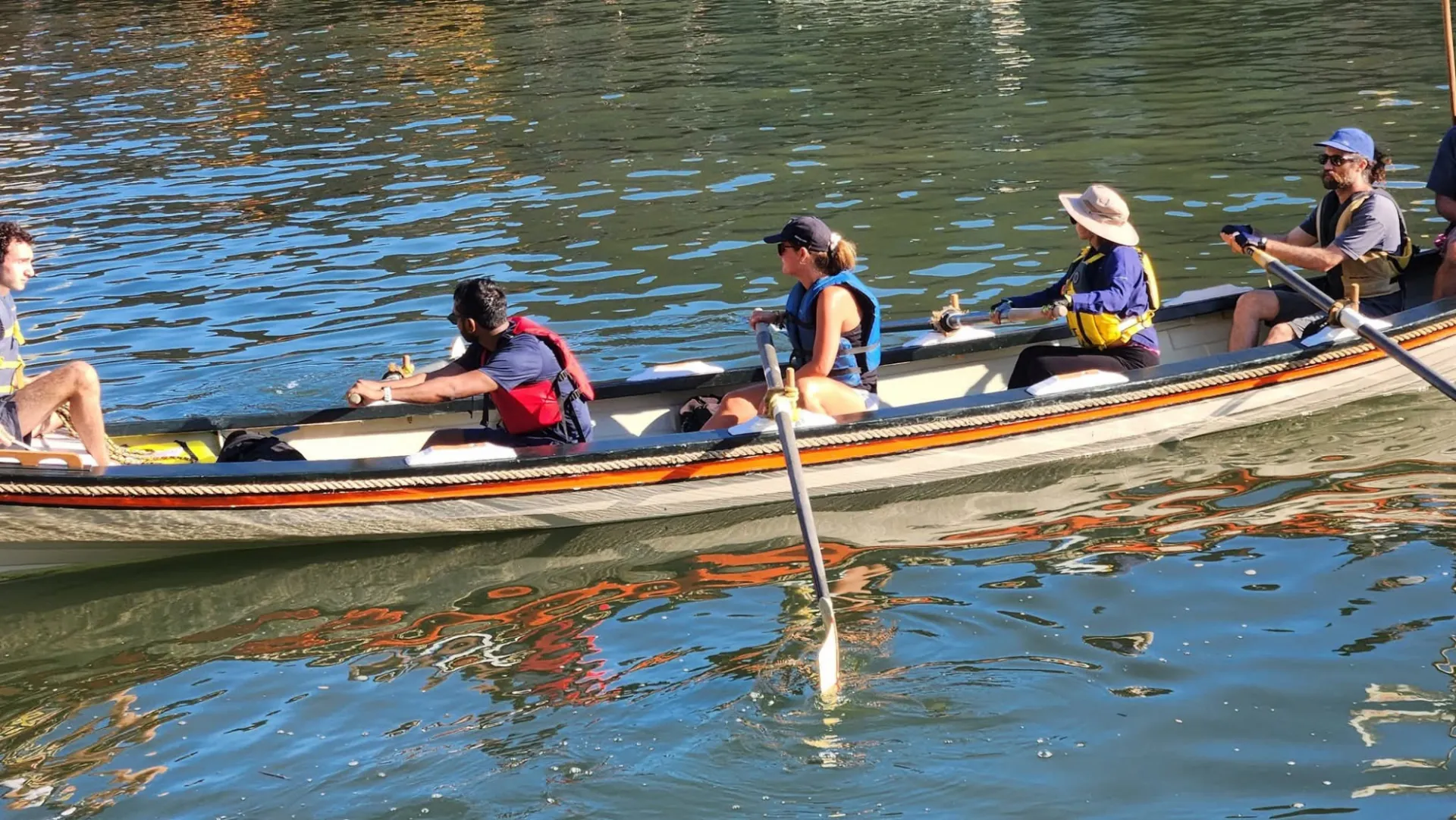
Thirty miles on the water is a really interesting way to see the city though, and I still enjoy rowing recreationally. I like to go up to Kingston and row in the calmer waters of the Hudson up there, though I don’t get to do that as much as I’d like!
Advice for your younger peers?
It’s very tough to give “one-size-fits-all” advice with PhDs, because everyone’s experience is so different. As a first-generation international student, I know firsthand that the non-research hurdles can be as demanding as the research. And even though it wasn’t long ago that I was a grad student myself, the world is a lot more challenging now than when I was starting out.
My general advice for current or aspiring PhD students is this:
- Choose your advisor carefully: find someone who supports not just your research but also your growth.
- Cultivate community: bring an empathetic presence to any environment you’re in, and seek out good mentorship.
- Most of all, lead with curiosity and humility: critical thinking and a willingness to learn and be corrected are among the most profoundly important skills for a scientist to possess inside and outside the lab.
A PhD is an excellent opportunity to cultivate these skills. Don’t be afraid to ask questions, to reason from first principles, and don’t run away from nuance and complexity; let them become your strengths. All of this is increasingly valuable in a world being transformed by generative AI, economic inequity, and the dwindling bandwidth of public discourse. And finally, strive to be a thoughtful communicator of your work; you’d be surprised to see how many doors open when you’re able to translate your work for the world. Come attend webinars and workshops I’ll be organizing this year to learn how!