
Quantum Q&A With Graduate Luca Nashabeh
The Churchill scholar and Columbia College ‘26 graduate reflects on his time at Columbia.
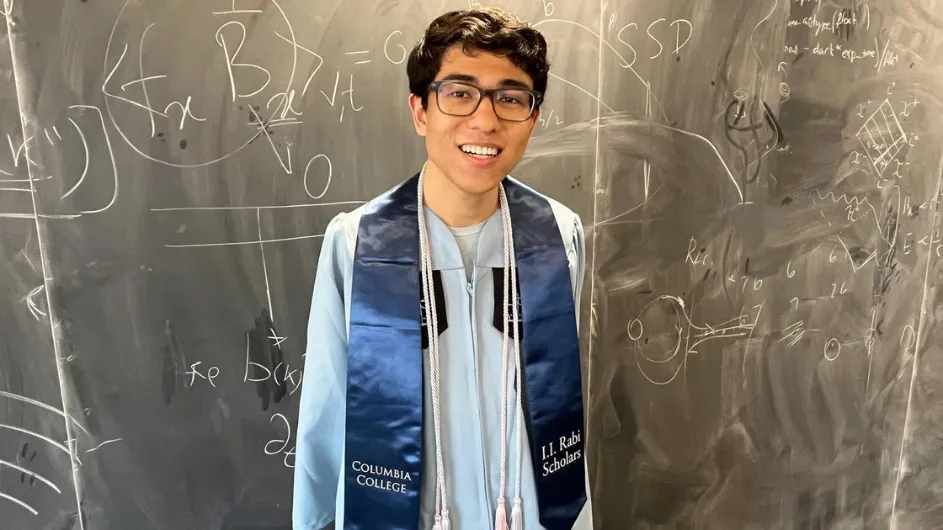
Congratulations to the Columbia Class of 2026, including undergraduate Luca Nashabeh!
Meet Columbia's Other Churchill Scholar:
Nashabeh, who hails from California, joined Columbia College as a Rabi Fellow, earned a Goldwater Scholarship along the way, and is leaving with his BA in physics and mathematics as a Churchill Scholar.
He has two Cambridges in his future: after his year in the UK at Cambridge University as a Churchill Scholar, he’ll be heading to Cambridge, Massachusetts to study condensed matter physics at MIT. Before Nashabeh leaves campus, he shared some highlights from his time at Columbia.
What sparked your interest in physics and brought you to Columbia?
In third grade, my parents bought me the Basher Science comic books. They spanned a wide range of topics, but I was particularly fascinated by the “extreme physics” book. It was quantum-adjacent and served as an introduction to things like protons and neutrons.
That sparked my interest in physics as a scientific discipline, but it was a very pop-science introduction. During my sophomore year of high school, I participated in a research-based physics tournament. We had a year to work on research problems that were very open-ended. I really enjoyed that style and knew I wanted to explore the frontiers of physics research in college.
I chose Columbia to step away from the West Coast for a bit and explore something different. I was offered a Rabi Fellowship, which really opened the door to research for me.
What were some of the research highlights from your time here?
I knew something in physics would be interesting, and I first worked with Professor Abhay Pasupathy. I started off exfoliating graphene, but Abhay connected me with a graduate student, Morgan Thinel, who was kind enough to let me attach myself to his work with a cryotemperature scanning tunneling microscope (STM) in the basement of Pupin. I was also mentored by his postdoc, Madisen Holbrook.
I worked on several quantum materials, including a project on palladium and ‘bound states in the continuum,’ charge density waves and ferromagnetism in chromium disulfur bromide, and imaging transition metal dichalcogenides (TMDs). From there, I transitioned into theory. Professor Raquel Queiroz put me in touch with a former student so I could help fill in some modeling gaps for Morgan’s project, and then I started on my own ground-up theory project with Hector Ochoa, a research scientist in the department. We looked at strain relaxation in rhombohedral graphene.
Last summer, I worked with Liang Fu at MIT on a project on electron-hole bilayer superconductivity. For me, that’s a really nice example of how great the Rabi Fellowship is: The program even supported my work at another university.
What is your big-picture interest in these areas?
Condensed matter physics has grabbed me because there’s so much mathematical intrigue. It’s a lot of fun math, but it’s also very grounded. I enjoy that you can do a lab-bench experiment and measure things in such a direct fashion. There is still lots to understand, especially as condensed matter has been growing so rapidly in the last few decades; topology, moire theory, and 2D materials are all exponentially growing with lots of potential applications.
What are your future goals?
I’m off to Cambridge for a year on the Churchill Scholarship, where I’ll be doing their Part III in Mathematics (their version of a master’s) with the Theoretical Physics Department. It won’t be exactly related to my PhD, but a last hurrah for my mathematical interests before I move to MIT.
My driving thrust is to use modern computational tools and models to find interesting behaviors in simple systems that have a lot of controllability. I’m interested in neural network quantum states, which are advanced Monte Carlo techniques. Monte Carlos are 60 years old, but they can produce remarkably accurate results for ground-state phase diagrams. It’s still a young field, but there’s a lot of potential, and I’m excited to see where it goes.
What are you taking with you from Columbia?
I have to appreciate Columbia’s Undergraduate Research and Fellowships Office for the amazing work they do for undergraduates. Beyond my education and what I learned from my research experiences, there are the friends that I made. Columbia Physics has a uniquely cohesive and strong undergraduate community. The department even has an undergraduate study room that is our “unofficial” hangout spot that only we know the door code to. That environment has been really great, and I hope to continue working with the people I’ve met for a long time to come. I was also involved in the Columbia University Airplane Club (CUAC) with no prior experience, and I took drawing and ichthyology (the study of fish) courses. I’ve definitely appreciated the opportunity to take classes just for fun.
What will you miss about New York?
I have excellent memories of New York. I’ve appreciated the food scene—I cook a lot myself, but I loved going to the different boroughs to try food. Cultural institutions like the Met, the Intrepid Museum, and the Frick are hard to beat.
Just exploring the city is great to escape the academic bubble. I’ve also really liked not having to own a car, and since I survived this winter, I’m good to stay on the East Coast for a bit.
Any words of wisdom to leave others with?
Definitely jump in as soon and as early as you can! It’s good to try different things to get a better sense of what you enjoy. In grad school, you become more locked in, but as an undergrad, you have the opportunity to experiment.
Columbia is a great place with amazing resources—research, academics, and fellowships. I would not be where I am, with these accolades and opportunities, without them. If you are at all interested in research or an academic path, use what’s available!