
Victoria Quirós-Cordero Manipulates Light at Smaller and Smaller Scales
The Columbia Quantum Initiative Postdoctoral Fellow shares her path from Costa Rica to Columbia and her interest in unique optical materials
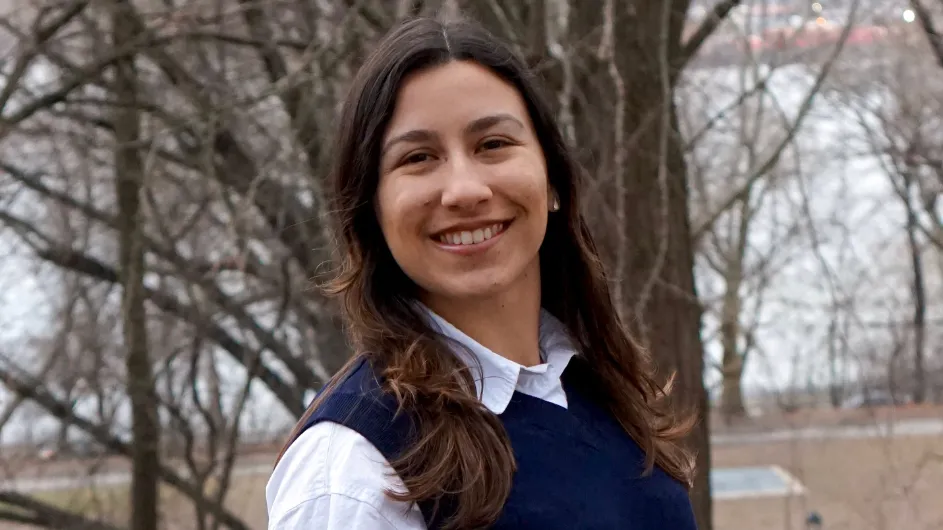
Last August, Columbia welcomed Victoria Quirós-Cordero as one of its first Quantum Initiative postdoctoral fellows. Quirós-Cordero, who originally hails from Costa Rica, joined Columbia after completing her PhD at Georgia Institute of Technology.
In Atlanta, she studied the optical properties of soft polymer-based hybrid materials. In New York, she’ll continue to study how to manipulate light in materials at even smaller scales. “I came to learn about two- and even one-dimensional materials and the techniques to study them,” Quirós-Cordero said. “The quantum material community at Columbia is so big, you can go from synthesizing a unique material and testing its optical and electrical properties to device fabrication and characterization—you can really be involved in every step of the process.”
She’s splitting her time between the labs of mechanical engineer Jim Schuck, an expert in non-linear optics and photonic device design, and chemist Milan Delor, who specializes in capturing the ultra-fast propagation of light, charge carriers (such as electrons), and hybrid quasiparticles they can combine into.
In this Q&A, Quirós-Cordero shares her enthusiasm for optics in different material systems and where she hopes her work might lead.
What sparked your interest in optics?
I’ve always been excited about physics that you can’t easily see, like the manipulation of electromagnetic fields, particularly light.
As an undergraduate at the University of Costa Rica, I was a double major in physics and electrical engineering, and I had the opportunity to join the Materials Science and Engineering Research Center. I really enjoyed characterizing the optical properties of different materials, so I continued exploring that.
What kinds of materials have you worked with so far?
I started with studying nanostructured metallic films in Costa Rica. My PhD thesis was on soft polymer-based hybrids, a non-conventional material for optics and photonics research. They are easier to fabricate into devices than silicon, and they could potentially be used in flexible and large-area applications, such as creating transparent mirrors that reflect heat or coating solar panels. We wanted to confirm that it’s possible to create microcavities from these soft materials, in order to make a type of quantum quasiparticle called an exciton-polariton.
At Columbia, I am excited to learn more about 1D and 2D materials, and I will be working on two main projects. The first involves materials known as transition metal dichalcogenides (TMDs); I’ll be designing structures to enhance their optical properties with the goal of making smaller and smaller light sources that could one day be integrated into photonic chips.
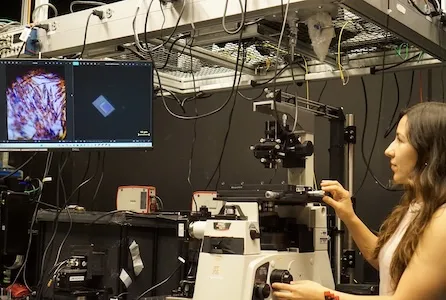
I’m also working with a one-dimensional material, a very new material created by collaborators outside of Columbia. It’s essentially a lattice made from wires that are just a few atoms thick, that we want to characterize from its most basic optical properties to more advanced ones, like how it transports light and charge carriers.
What’s the end goal of this work?
If you look at the optics and photonics industry, the materials are mostly silicon, metals, and some semiconductors. But there are so many different materials with unique optical properties that we haven’t yet explored.
Ultimately, I would like to contribute to expanding the capabilities of the optics and photonics industry and to making it less energy-intensive and more accessible. Coming from a smaller university with less research funding and a country with less investment, it would open up a lot of opportunities if more materials were available that were less expensive to work with. I think it’s really important to reach communities that don’t have as much access and resources.
That’s probably still a long way away, but shorter term, I’d love to see more scientists, in academia and industry, using the new materials we are exploring in their optical research.
How have you been enjoying your time in New York so far?
I miss a little of the southern hospitality in Atlanta. New York feels more competitive and busy, but once you adapt, I think you can really use that to push and motivate you. I’ve been spending a lot of my time so far getting to know people at Columbia. We’re really encouraged to create collaborative projects, and I already have a few in mind, just from talking over coffee.
Outside campus, I really enjoy Riverside Park. I love walking my dog, Juli, there with my husband, Esteban Rojas-Gatjens. He’s also a Columbia Quantum postdoc, working with Xiaoyang Zhu to study quantum phases in different materials as they change over time.
Any words of advice to young scientists?
First, find your voice as a scientist. Why do you want to do this work? Science is so fast-paced, you need to think about what you are passionate about and how you can contribute. I’m very proud to see how I changed during my PhD, and to see myself confidently talk about my work—especially in a second language, where it can be hard not to get so caught up in things like grammar and pronunciation that you lose your own voice and personality.
And second, be humble and kind. If you don’t know something, you can learn it.