Columbia Physicist Sebastian Will Receives Moore Experimental Physics Investigator Award
He will receive $1.35 million over five years to develop a new approach to create ultra-precise optical atomic clocks.

In news announced today by the Gordon and Betty Moore Foundation, Columbia physicist Sebastian Will has been selected as one of 21 investigators to join the 2026 cohort of Experimental Physics Investigators. The initiative recognizes mid-career researchers who are pushing the boundaries of the field.
Will will receive $1.35 million over the next five years to develop a new device to measure time that combines the precision of today’s optical atomic clocks with a more compact and robust architecture based on atomic arrays.
“Optical atomic clocks are among the most precise timekeeping devices ever made, but they remain largely restricted to laboratory settings,” said Will. “With the support from the Moore Foundation, my lab will explore a new architecture for optical atomic clocks that can make it easier for such clocks to be deployed in the real world.”
The standard for time, the second, is currently defined by cesium atomic clocks, which steadily “tick” about 10 billion times per second. The underlying concept for such clocks was first proposed in 1945 by Columbia Physicist I. I. Rabi, and uses atomic oscillations in the microwave domain. Optical clocks instead utilize transitions in atoms, such as aluminum and strontium, that oscillate tens of thousands of times faster, enabling even more precise time measurements. But these clocks require complex optics and laser systems and ultrahigh vacuum chambers to construct. Only a few high-performance optical atomic clocks currently exist in specialized labs around the world.
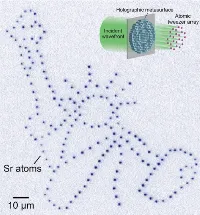
Will proposes a new way to create optical clocks based on arrays of individual strontium atoms. For this, he leverages a breakthrough combination of optical tweezers and metasurfaces. With his collaborator Nanfang Yu, an applied physicist at Columbia Engineering and 2022 Moore Experimental Physics Investigator, Will recently demonstrated that optical tweezer arrays generated by metasurfaces offer a path to precisely trap thousands of individual strontium atoms. Each of these individual atoms can serve as an extremely fast oscillating pendulum for the atomic clock.
Will’s metasurface atomic tweezer arrays offer a more compact, simpler way to trap individual strontium atoms for use in a new atomic clock architecture. With the Moore Investigator Award, he plans to build strontium clocks with up to 10,000 atoms to achieve high clock precision, increase clock stability, and explore ways to potentially connect those clocks into a quantum network.
This project will enable the Will lab to venture into precision measurement. “In my laboratory, we are always excited to build experimental platforms that push into regimes previously considered impractical or out of reach,” said Will, whose lab has recently reported the first Bose-Einstein condensate of molecules and the first observation of molecular droplets. “We are excited to apply a combination of new technical ideas and exploratory thinking to optical atomic clocks.”
Image Carousel with 3 slides
A carousel is a rotating set of images. Use the previous and next buttons to change the displayed slide
-
Slide 1: Artist's rendition of an atomic tweezer array generated by a holographic metasurface. Credit: Will Lab, Columbia University
-
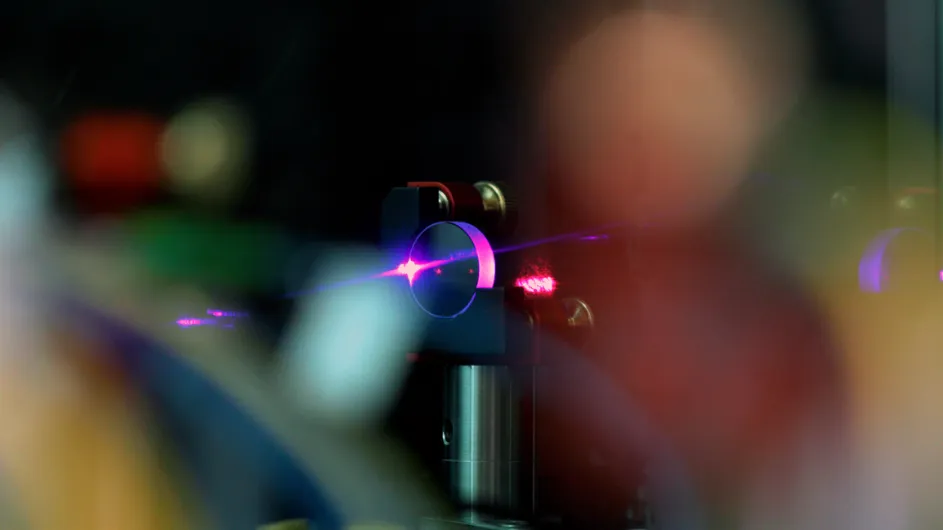
Slide 2: An optical system in the Will Lab for preparation of ultracold strontium atoms. Credit: Will Lab, Columbia University
-
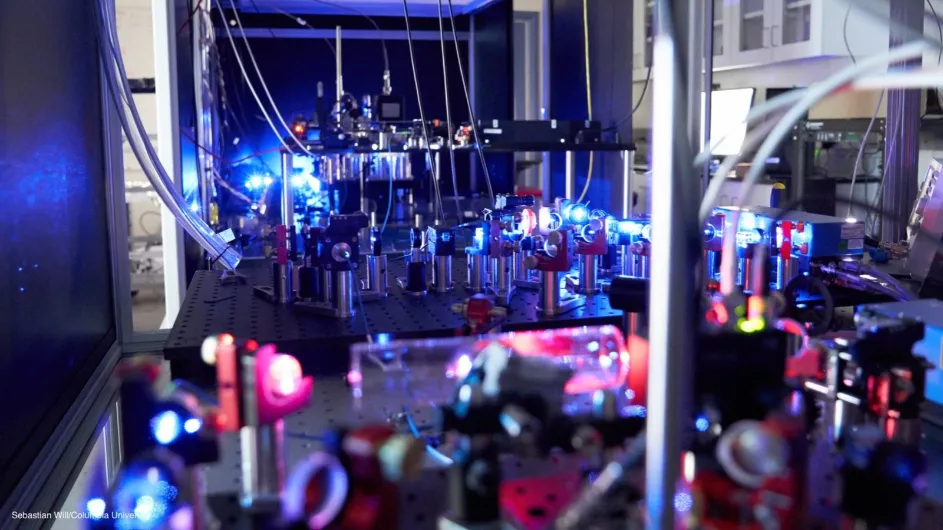
Slide 3: Experimental setup in the Will Lab for the creation of strontium atomic arrays. Credit: Will Lab, Columbia University