
Columbia Scientists Explain How Atomic Disorder Controls Heat
Research led by Michele Simoncelli establishes a new framework that links atomic-scale disorder to heat conduction, paving the way for the theory-driven design and discovery of more efficient heat-shielding materials
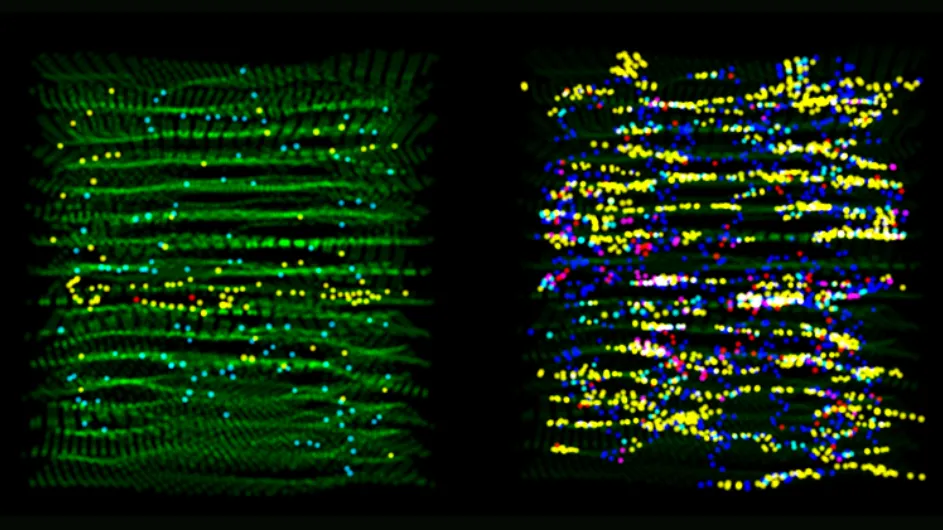
Carbon is an exceptionally versatile element that plays a crucial role in numerous industrial applications. It moderates reactions in nuclear power plants (e.g., graphite moderator blocks in fission reactors); as a fundamental electrode material in batteries and supercapacitors, it underpins modern energy storage; and in the form of heat spreaders and thermal interface materials, it enhances the performance and reliability of electronic devices and power modules. Optimizing these applications requires an understanding of how carbon, in its different forms, transports heat.
In a new paper published on December 4 in Physical Review X, Columbia researchers Kamil Iwanowski and Michele Simoncelli, along with their University of Cambridge colleague Gábor Csányi, introduce a mathematical descriptor and a physical framework that together provide a quantitative explanation for how the amount of disorder in the atomic structure of materials influences their capability to transport heat.
“Technologies ranging from nuclear fusion to solar cells depend on the properties of materials whose atomic structure lies between that of well-studied, perfectly ordered (periodic) crystals and completely disordered (amorphous) glasses. Imperfect “real-world” materials can thus be seen as the “unconventional shades of gray” of condensed-matter physics,” said Simoncelli, assistant professor of applied physics and applied mathematics at Columbia. “Here we introduce a framework to quantitatively describe, understand, and engineer their physical properties and functionalities. We look forward to using this framework in collaboration with experimentalists and industry to improve current heat-management materials or even to design new ones.”
Their framework is applicable to a wide range of solid materials, and it solves a 76-year-old problem in physics.
In 1949, Bell Labs physicist Charles Kittel proposed a phenomenological model connecting a material’s thermal conductivity (the physical measure of heat conduction) to “obstacles” that disturb the microscopic vibrations of its atoms. In this picture, heat flows easily when these obstacles are far apart, and much less efficiently when they are closer together. Experiments suggested that this characteristic distance is determined by imperfections in how atoms are arranged, but for decades, it remained unclear how reliable this connection was.
“We solve this problem by demonstrating fundamental physical relations between variability in the arrangements of atoms, their microscopic vibrational patterns, and the length scales over which vibrations transport heat,” said Iwanowski, the first author of the paper and graduate student in Simoncelli’s research group at Columbia, which he established earlier this year.
Simoncelli’s group is interested in carbon for its applications, especially in green energy technologies, and because it is a realistic example of a network solid that can have high variability in the way atoms are connected. In fact, carbon can bond with two, three, or four other carbon atoms. That results in considerable structural diversity, several imperfections, and potential networks of bonds. What remained an extremely challenging problem was quantifying these features and relating them to macroscopic properties.
In the current work, the team modeled the properties of 23 different forms of carbon at the quantum mechanical level and quantified their structural disorder using their newly introduced Bond-Network Entropy (BNE) growth descriptor, which measures the number of different local bond networks that connect the atoms. They further established clear links between structural disorder, motifs of atomic vibrations, and overall thermal conductivity.
Although they focused on carbon here, the theoretical and computational framework they developed is applicable to a wide range of network solids, where atoms are bonded through strong covalent bonds. From here, they are working to relate it to experimental measurements and thinking about future applications. For example, materials in fusion reactors are exposed to neutron irradiation, which induces defects in their bond network. The framework allows scientists to quantitatively predict how the neutron-irradiation-induced changes in atomic structure affect a material’s macroscopic properties. This will ultimately enable predictions about the durability and reliability of materials that operate under extreme conditions.
“Having a quantitatively accurate theory that predicts how materials behave in extreme environments is incredibly useful, as it allows us to replace very expensive and challenging experiments with fast and accurate simulations. This will greatly accelerate the development of more efficient materials,” said Iwanowski.
Read More: Kamil Iwanowski, Gábor Csányi, and Michele Simoncelli. Bond-Network Entropy Governs Heat Transport in Coordination-Disordered Solids. Physical Review X (2025). DOI: https://doi.org/10.1103/w4p6-b9mp