
Ultracold Molecules Are Now Ultrastable
Physicist Sebastian Will has created a new molecular platform for discovering new quantum phenomena.
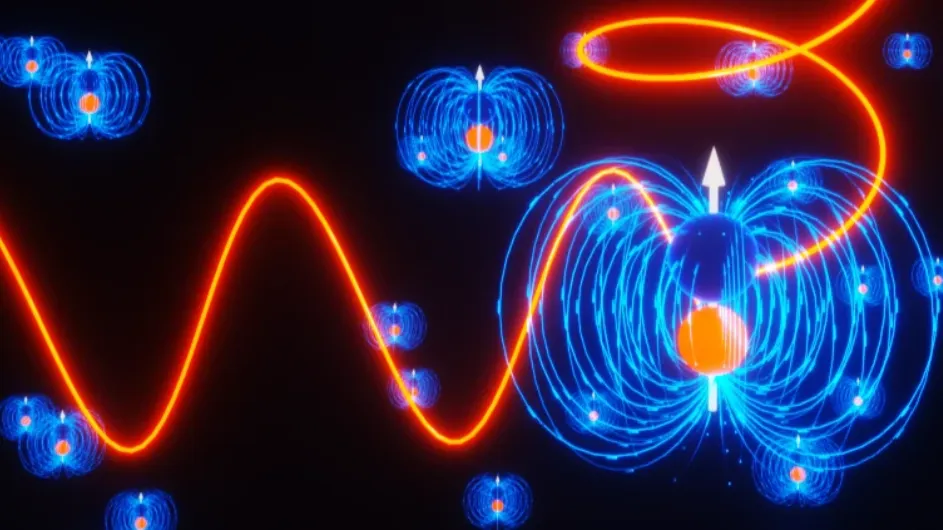
In new research published today in Science, Columbia physicist Sebastian Will and his lab have demonstrated that ultracold molecular gases can be stabilized against losses to an extreme degree—a critical step in turning dipolar molecules into a versatile platform for quantum simulation and the exploration of novel quantum states of matter. Their new ultracold molecular platform may help researchers explore the origins of enigmatic quantum phenomena, such as high-temperature superconductivity, and realize entirely new ones.
“For such a long time, it seemed almost impossible to stabilize ultracold molecules. Loss processes and chemical reactions severely limited the lifetime of molecules at ultracold temperatures,” said Will, “Now, we have not only been able to suppress such processes below the detection limit, but also show that this is possible even in the presence of strong dipolar long-range interactions.”
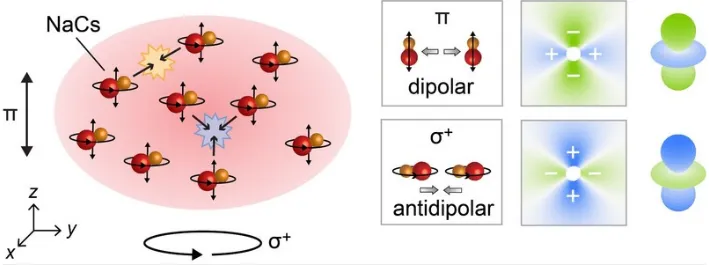
Sodium-cesium (NaCs) molecules, those used in this study, are dipolar. One end is slightly positively charged, while the other is slightly negatively charged, giving rise to interactions that are similar to those between bar magnets. As a result, they can “feel” each other across relatively long distances. How dipolar molecules interact depends on their orientation and the strength of their polarity. These are features that are highly desirable for a quantum simulation but, until now, have been challenging to control.
Will and his lab address this issue using a technique they call “microwave dressing,” which they developed with their theoretical collaborator and co-author, Tijs Karman, at Radboud University. Microwaves can effectively create protective shields around each molecule. These shields minimize destructive collisions between the molecules while also allowing the team to manipulate the orientation and the strength of dipolar interactions with high precision.
Will and his colleagues recently used microwave dressing to create the first molecular Bose-Einstein Condensates (BEC) and observe the first formation of molecular droplets. The BEC results showed that the team could cool the molecules to nanokelvin temperatures, reaching a state known as “quantum degeneracy.” The subsequent observation of droplets was their first hint that an ultracold molecular gas could realize novel quantum phases in the presence of strong dipole-dipole interactions. In the current work, they demonstrate just how well they can fine-tune ultracold NaCs molecules.
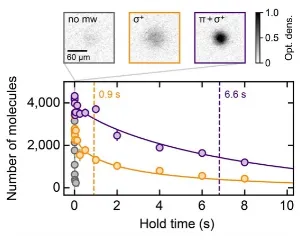
Using two sets of microwaves, they reduced the number of destructive collisions between pairs of molecules by more than a factor of 10,000 and between three molecules by more than a factor of 1,000. That stabilized samples for more than six seconds; without the microwave dressing, the molecular lifetimes spanned just a few milliseconds. “Remarkably, our data showed that this extremely high stability could be retained, even in regimes where the dipolar interactions were strong. Whether that would work was completely unclear before,” points out graduate student Weijun Yuan, the first author of the current Science paper.
Tightly packed while loss processes are fully suppressed, these NaCs molecules can now create entirely new systems, like droplets and droplet arrays, that are driven by dipolar interactions and may give access to enigmatic quantum states, like supersolids. “The combination of extremely low losses with the ability to flexibly control the strength of dipolar interactions is really key to reaching the so-called ‘strongly interacting regime’ with ultracold molecules. The regime of strong interactions is often where new quantum states of matter can be found,” said Will.
The team will also explore how ultrastable molecules will behave in optical lattices, allowing the quantum simulation of magnetism and potentially the realization of elusive spin liquids.“I am most excited to see whether molecular systems can reveal new types of quantum order that we did not have on the radar before,” said Will.
Read More: Weijun Yuan et al. Extreme loss suppression in an ultracold molecular gas with widely tunable dipolar interactions. Science 2026. DOI: 10.1126/science.adz0521