
Physics Today covers advances in magic angle twisted graphene, including work from Columbia Physicist Cory Dean
Columbia University joins the Flatiron Institute and Germany’s Max Planck Society for the Advancement of Science to establish the Max Planck - New York City Center for Nonequilibrium Quantum Phenomena
Columbia researchers invent a new way to tune the properties of 2D materials by adjusting the twist angle between them; technology enables the development of nanoelectromechanical sensors with applications in astronomy, medicine, search and rescue, and more.
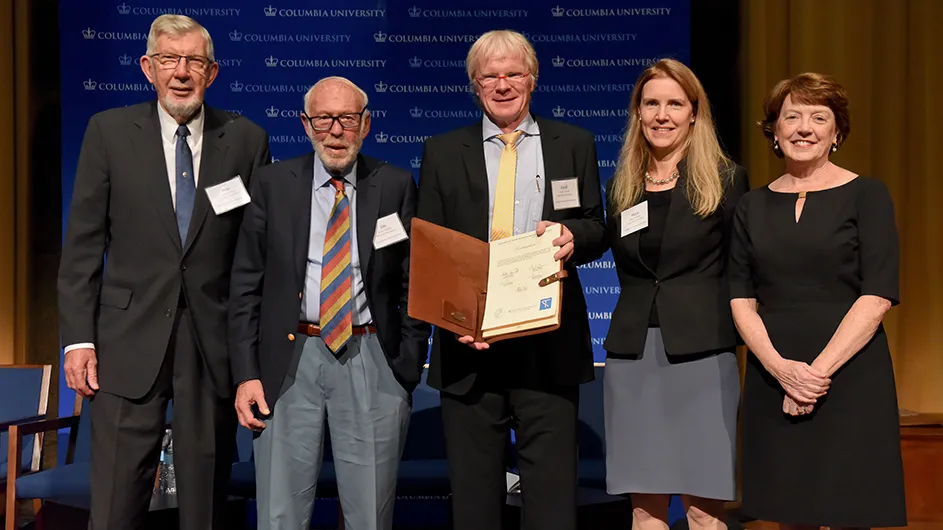
Working together with the Flatiron Institute in New York City and the Max Planck Society in Germany, the University will harness quantum materials for wider applications and technologies.
Researchers propose a new approach—using a photonic-chip platform based on silicon nitride—to attain highly entangled photon states, essential to quantum computing and technology
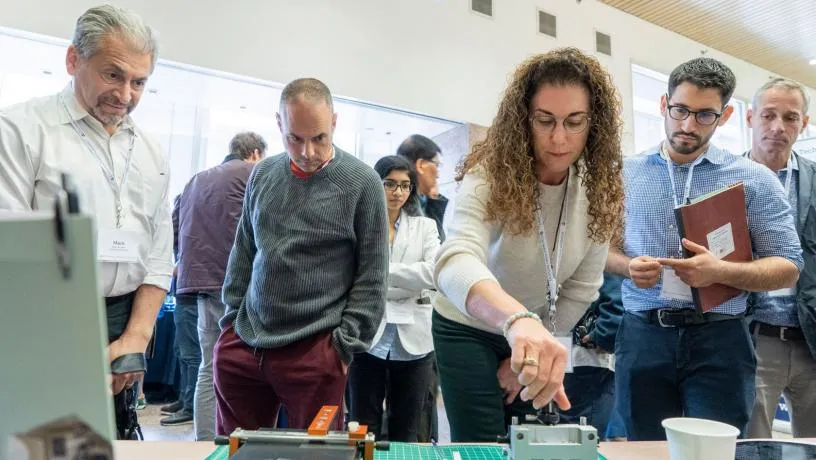
Using Columbia’s nano facilities, over four hundred researchers have achieved nearly three hundred inventions and patents.
Columbia researchers Sebastian Will (Physics), Ana Asenjo-Garcia (Physics), and Nanfang Yu (Applied Physics) have been awarded $2 million for a project aimed at extending the excited state lifetime of atoms.
Physics Today covers new research on molecular clocks from Columbia Physicist Tanya Zelevinsky
Quantum materials physicist Cory Dean is quoted in a Science news story about recent work showing superconductivity in trilayer graphene.
Cory Dean, Professor of Condensed Matter Physics, and Timothy Berkelbach, Assistant Professor of Chemistry, have been named recipients of the Presidential Early Career Award for Scientists and Engineers (PECASE).
Leaders in the field of ultracold molecule research from Columbia and Harvard Universities are teaming up to propel understanding of the quantum mechanics of chemical reactions.