
Researchers from Brown and Columbia Universities have demonstrated previously unknown states of matter that arise in double-layer stacks of graphene, a two-dimensional nanomaterial. These new states, known as the fractional quantum Hall effect, arise from the complex interactions of electrons both within and across graphene layers.
Dmitri Basov, Higgins Professor of Physics at Columbia University, has been awarded the Vannever Bush Faculty Fellowship for 2019. The honor, which is one of the U.S. Department of Defense’s most prestigious awards, aims to foster research that probes the limits of today's technologies and has potential for transformative impact.
Superconductivity, magnetism, and other forms of interacting electron behavior—bilayers of graphene seem to have it all. Researchers are now using this pristine material to unlock the secrets of interacting-electron phenomena with unprecedented control and tunability
Michal Lipson is a pioneer whose seminal research underpins the explosive growth and rapid commercialization of silicon photonics, a technology that uses optical rays to transfer data among computer chips. She spoke with Columbia Engineering about the joy of physics, putting all your eggs in one basket, and young female researchers taking charge of their careers.
Honoree recognized for pioneering contributions to the fields of quantum and nonlinear photonics
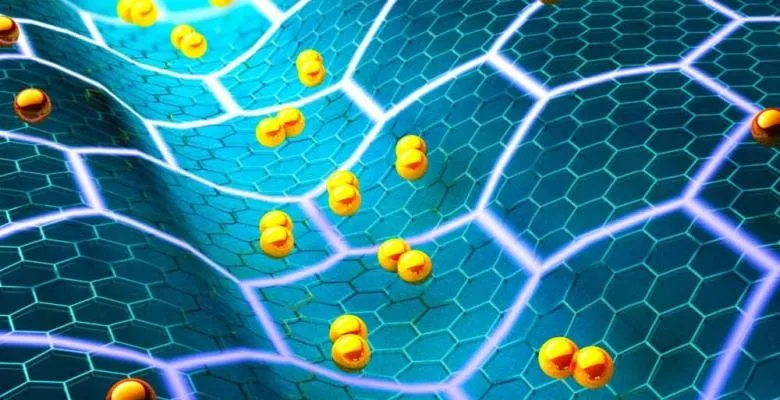
A Columbia University-led team has developed a new method to finely tune adjacent layers of graphene—honeycomb-like, 2D sheets of carbon atoms—to induce superconductivity. Their research provides new insights into the physics underlying this material’s intriguing characteristics.
Experiments track a simple molecule dissociating to find when the reaction can be described with a quantum model and when a semiclassical one will do.
In a highly interdisciplinary collaboration, researchers across Columbia Engineering, Columbia University Department of Chemistry, Shanghai Normal University, and the University of Copenhagen have upended conventional wisdom, synthesizing the first molecule capable of insulating at the nanometer scale more effectively than a vacuum barrier.
A Columbia University-led international team of researchers has developed a technique to manipulate the electrical conductivity of graphene with compression, bringing the material one step closer to being a viable semiconductor for use in today’s electronic devices.
In a new study, researchers have fabricated the first superatomic 2-D semiconductor, a material whose basic units aren't atoms but superatoms—atomic clusters that exhibit some of the properties of one or more individual atoms.
Researchers at Columbia Engineering, experts at manipulating matter at the nanoscale, have made an important breakthrough in physics and materials science, recently reported in Nature Nanotechnology. Working with colleagues from Princeton and Purdue Universities and Istituto Italiano di Tecnologia, the team has engineered “artificial graphene” by recreating, for the first time, the electronic structure of graphene in a semiconductor device.
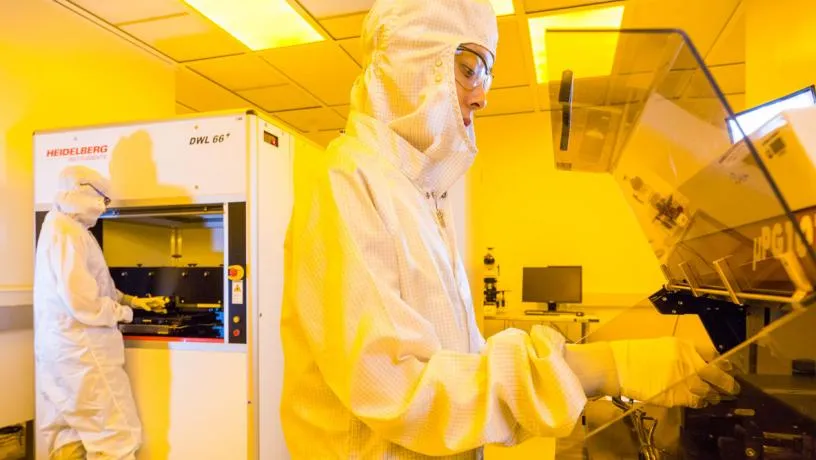
When it comes to conducting ultrafine research on a nanoscale, even one speck of dust could short out a piece of microelectronics operating at the atomic level.