
The Quantum Networks Town Hall and Domestic Cooperation Workshop took place February 27 and 28 at the SUNY Global Center in midtown Manhattan.
Recent work on quantum entanglement from Jim Schuck’s lab leads the March issue of Nature Photonics
PNAS Commentary on Quantum tunneling and its absence in deep wells and strong magnetic fields by Charles L. Fefferman, Jacob Shapiro, Michael I. Weinstein.
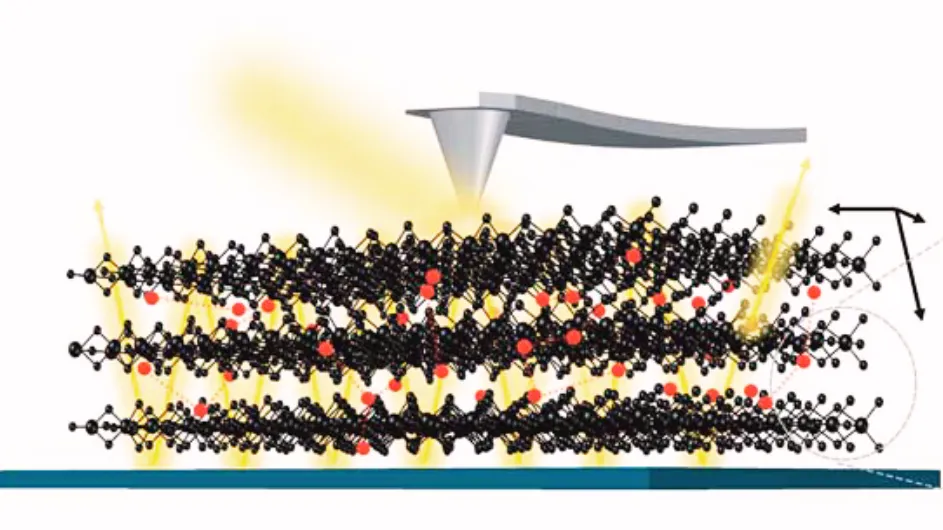
Bad metals have unique electronic properties that make them a good place to look for elusive quantum particles.
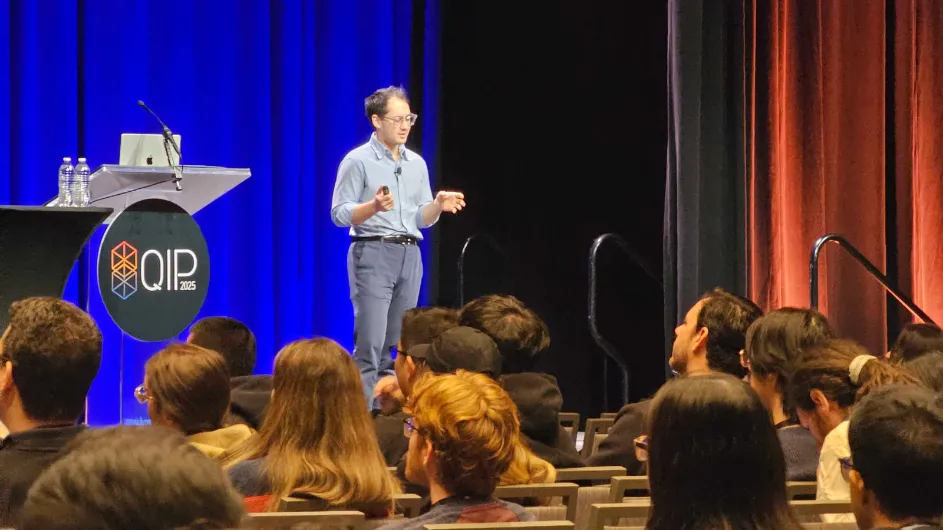
This year's Quantum Information Processing (QIP) Conference welcomed more plenary talks from Columbians.
His research, advised by Henry Yuen, is focused on studying the powers and limitations of quantum computers, and discovering the implications of both.
In Laser Focus World | All-optical nanoscale sensor of force changes intensity when pushed or pulled
Researchers discover photon avalanching nanoparticles are supersensitive to mechanical force—and nanosensors they went on to create are poised to redefine what’s possible in terms of sensitivities and dynamic ranges of optical force sensors.
The discovery of a small discrepancy in hydrogen’s atomic spectrum came at just the right time to push quantum theory forward.
A team of researchers led by physicist Cory Dean of Columbia University have found that ultrathin sheets of tungsten diselenide—layered in a twisted moiré arrangement—take on superconducting powers when cooled to temperatures hovering just above absolute zero.
Far-field stroboscopic scattering microscopy tracks the propagation of both fundamental and second-harmonic waves within van der Waals waveguides, allowing parameter-free determination of phase-matching conditions.